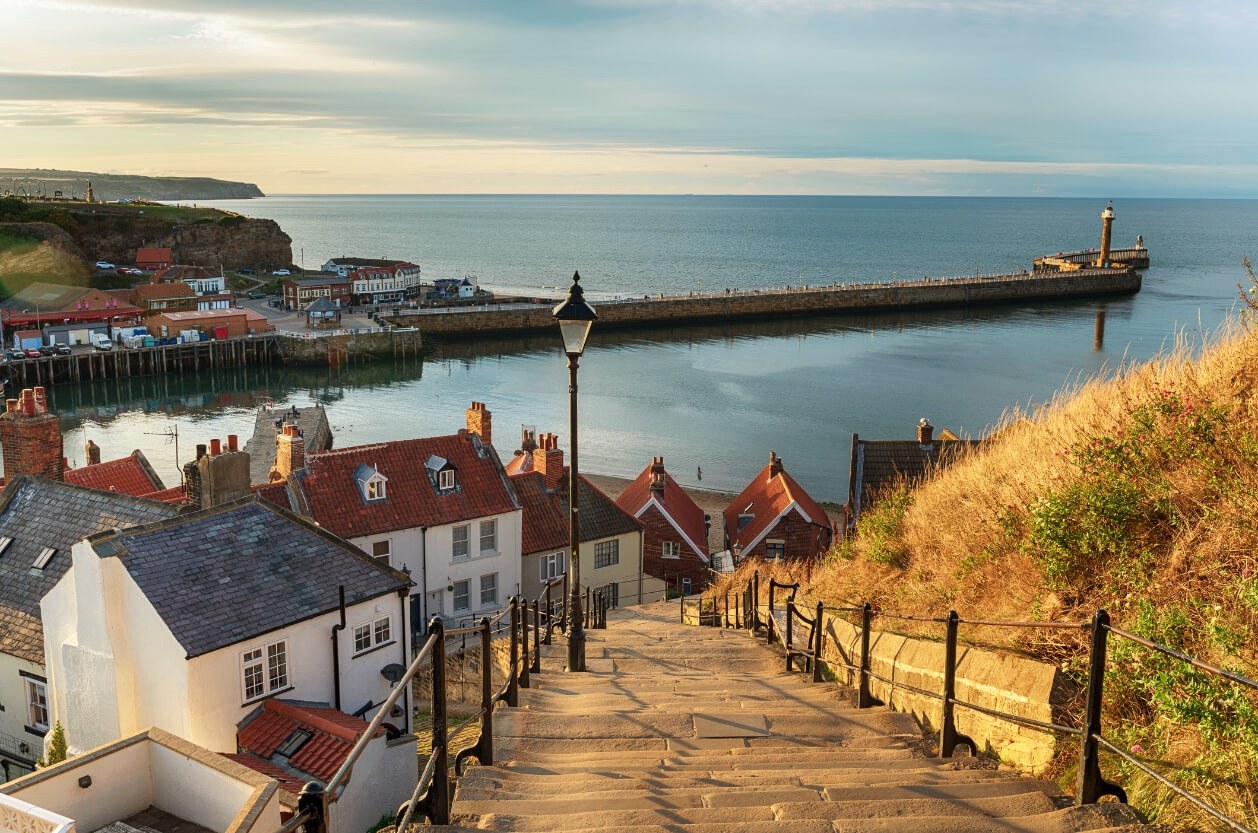
Half past eight on a Friday evening, and there was nobody in St Mary’s churchyard at all. We had come up the 199 steps on a whim, because the abbey had shut and there was an hour to kill before the last bus, and we ended up sitting among the gravestones for twenty minutes without really speaking. The whole town below us: red pantiles, the harbour mouth, the two piers reaching out into a flat sea. The abbey ruins going the colour of wet sand behind the wall. Our dog flat out on the grass, having taken the steps at a pace I could not.
It cost nothing, and it was the best part of the Whitby leg.
That is the version of Whitby I would sell you if you are bringing a dog. Not the beach. The beach is the problem, and almost nobody planning this trip finds that out until they are standing in front of the sign.
The thing the cottage websites keep quiet about
Between 1 May and 30 September, dogs are banned outright from the signposted zones on Whitby’s West Cliff beach. Not lead only. Banned. The fixed penalty is £100, enforced by North Yorkshire Council under a Public Spaces Protection Order, and the restricted stretch is the big obvious sweep of sand that everybody pictures when they picture Whitby.
Sandsend, which is where most people are told to go instead, is in the same order. So is Scarborough’s North and South Bay and Filey. Tate Hill, the small beach tucked under the abbey on the east side, stays open all year but dogs must be on a lead and it is not somewhere you would spend an afternoon.
Read a few of the guides and you will see this described as “restrictions apply in some areas” or “dog friendly outside the summer season”. Both are technically true and both are useless if you are arriving in August with a dog who wants to swim. The businesses writing those sentences are selling you a bed in Whitby, and the ban is inconvenient to that.
The fix is simple once you know: Robin Hood’s Bay has no dog restrictions at any time of year. Six miles down the coast, no seasonal zones, no signs, no fine. Once we knew that, the shape of the whole weekend fell out of it. Whitby becomes an evening. The Bay becomes the day.
Where to stay
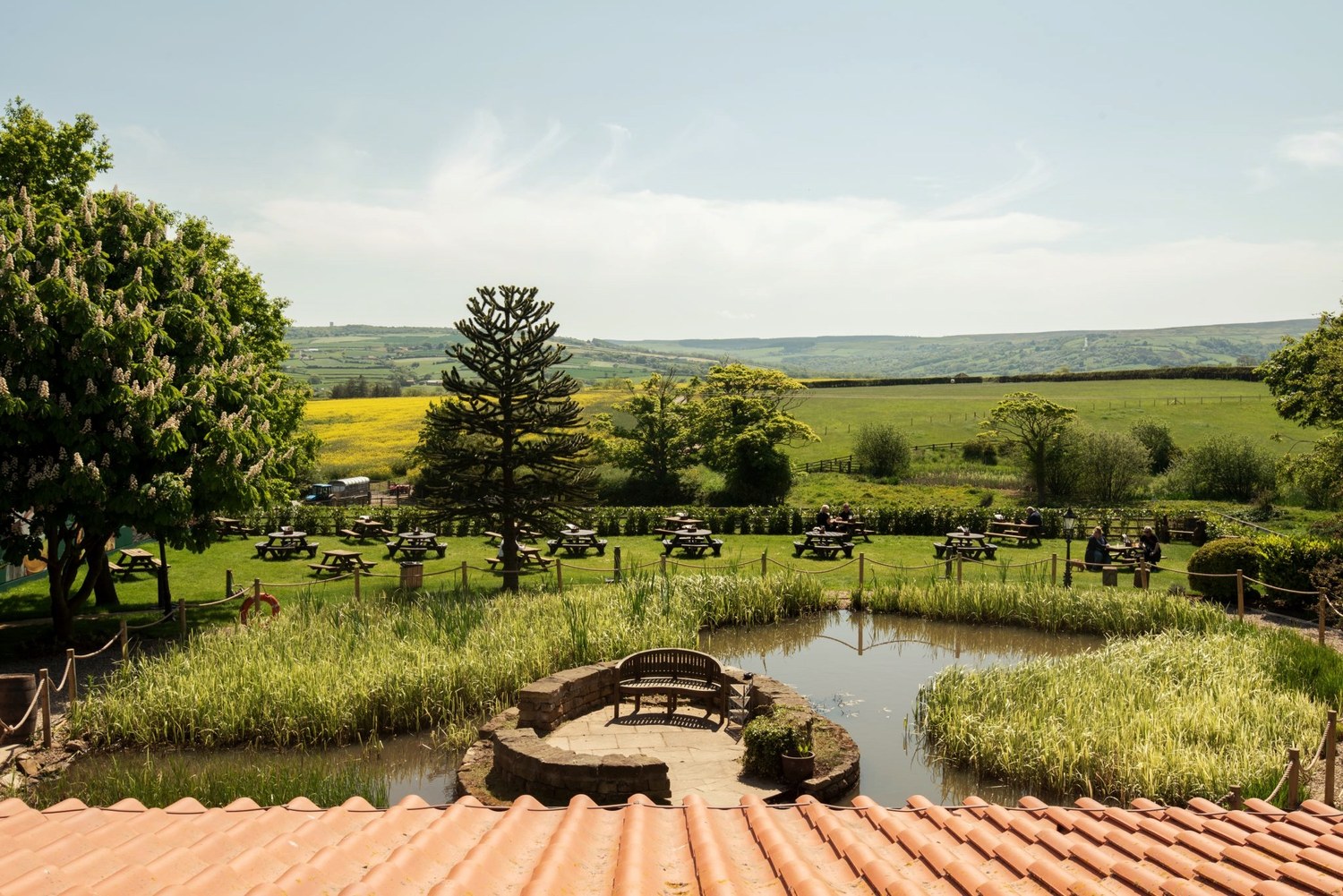
We stayed at The Stables at Cross Butts, on Guisborough Road right on the edge of town where Whitby starts turning into countryside. It is a 17th century farmhouse with rooms set round a courtyard of converted stables, oak beams and flagstones, plus a newer wing if you would rather something modern. The Inn Collection Group run it now.
A budget double was about £180 a night when we stayed, breakfast included and parking free. Check dates and prices at The Stables.
It is genuinely dog friendly rather than dog tolerated, and there is a real difference. Dogs go in the pet friendly rooms and in designated parts of the bar, so we ate dinner with ours asleep under the table. There were treats and a bowl waiting in the room when we arrived. The dog charge was £7.50 a night when we went, which is worth confirming when you book.
Two things nobody told us.
The first is good: the Whitby Park and Ride is directly opposite. Walk out of the car park, cross the road, and you are at the bus. That is the single best thing about the location and it is why we never even tried to park in Whitby.
The second is the peacocks. There are peacocks wandering the grounds. Our four legged friend lost his mind, comprehensively, and if yours is at all bird-obsessed you want to know that before you open the car door rather than after.
If you would rather stay at Robin Hood’s Bay
We based ourselves at Whitby because of the Park and Ride, and I would do it again. But if the Saturday loop is the reason you are coming, there is a real case for staying at the Bay and walking from the door. Both of these sit at the top of the village, a couple of minutes from the Cinder Track and the clifftop path, so the walk starts without a climb, and both put the village down the bank and back up again. We have not slept in either, so take these as a steer rather than a verdict. What separates them is what happens at dinner.
Hotel Victoria is the grander of the two, a Victorian hotel looking straight down over the bay with a big garden and the best view in the village. Its dog friendly rooms are in the Captains Quarters, next door to the main building. The catch is that dogs are not allowed in the main restaurant, so ask how breakfast and dinner actually work before you book rather than working it out on the first evening. Check dates at Hotel Victoria.
The Grosvenor is a pub with rooms rather than a hotel, red brick and Victorian, on the square a couple of minutes away, and dogs are welcome in the bar where the food is served. Log burner, pool table, live music some evenings, full English in the morning. It has an unusual number of repeat guests for a village with this much passing trade, which tells you something. Parking is free in the car park across the road rather than on site. Check dates at The Grosvenor.
Friday evening: Whitby, on the bus
We arrived late afternoon, dumped the bags and went straight over the road to the Park and Ride rather than joining the queue for a town centre space. Dogs travel free at the driver’s discretion and ours was no trouble. Twenty minutes and you are at the bus station.
Get the timing right, because this is where it bites. The 2026 service runs seven days a week from 29 March to 1 November. But the late buses only run during the summer school holidays, which this year means 19 July to 6 September. Outside those seven weeks the last bus leaves the Park and Ride at 6:30pm and Whitby Bus Station at 6:44pm. There is no evening in town on that timetable.
That matters most if you have driven to the Park and Ride, because the car park is closed and locked fifteen minutes after the last bus, and there is no facility to reopen the site to recover vehicles left after closure. Staying at The Stables we were spared that one, since the car never left the hotel. Anyone who has driven up and parked is looking at a taxi and a car they cannot reach until the morning. Either way, check the timetable for the dates you are going rather than assuming, and check it before you order a second drink. We caught the last bus back with about half an hour spare and it still felt tighter than I would have liked.
The abbey had shut by the time we got in, so we did not bother with tickets and went up the 199 steps instead. They are free, they are the better half of the experience, and the view back down them is the one everybody actually photographs. If you or your dog would struggle with the steps, Caedmon’s Trod runs alongside them: it is the old donkey road and a much gentler slope.
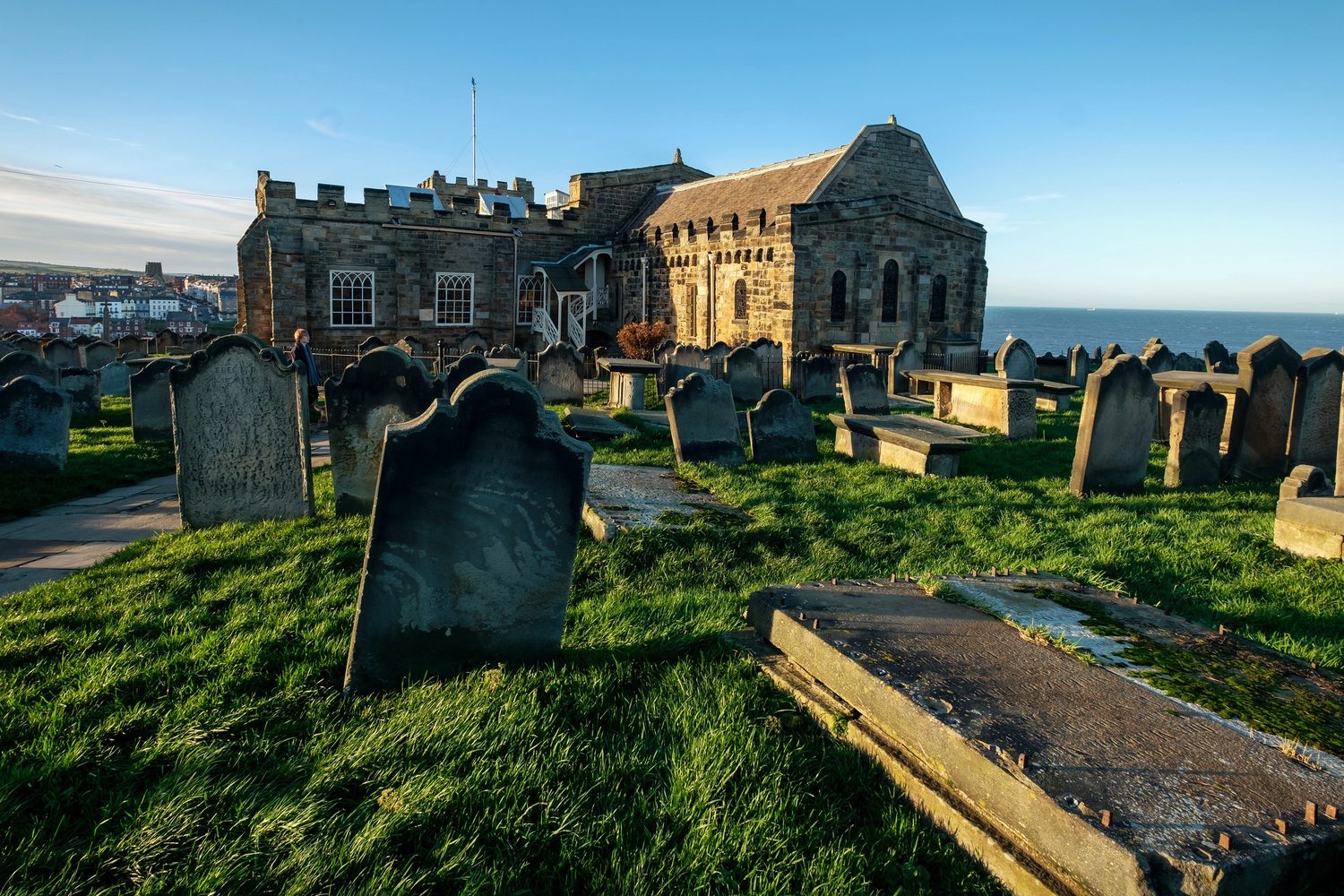
At the top, St Mary’s churchyard. Weathered gravestones leaning at angles, the town laid out below, the abbey wall behind. Empty in the evening. Sit down for a bit.
Then fish and chips at Hadley’s on Bridge Street, just over the swing bridge on the east side, on the bend past the Dolphin. There is a designated dog area near the front with water bowls down, and our four legged friend was very happy with his sausage, though by that point he would have eaten anything. It is about two minutes from the bottom of the steps, so you can come down off the churchyard and be eating within ten.
Book it if you can. We had not, and we got lucky. The dog area is only a few tables and it can be capped when the place is heaving, which in August it will be.
After that we walked out along the west pier as the light went, which costs nothing and is one of the genuinely lovely things to do in that town.
Whitby, the honest version
Worth your time. The 199 steps and St Mary’s churchyard, free, and the view is the actual thing people come for. Dogs are welcome inside the church too, though ring ahead if that matters to you. The piers, especially in the evening, and you can walk the dog the full length of both. And Whitby jet, which is a real local material with a real history rather than a manufactured souvenir. Buy from a proper dealer, not a gift shop, and you are getting something genuine.
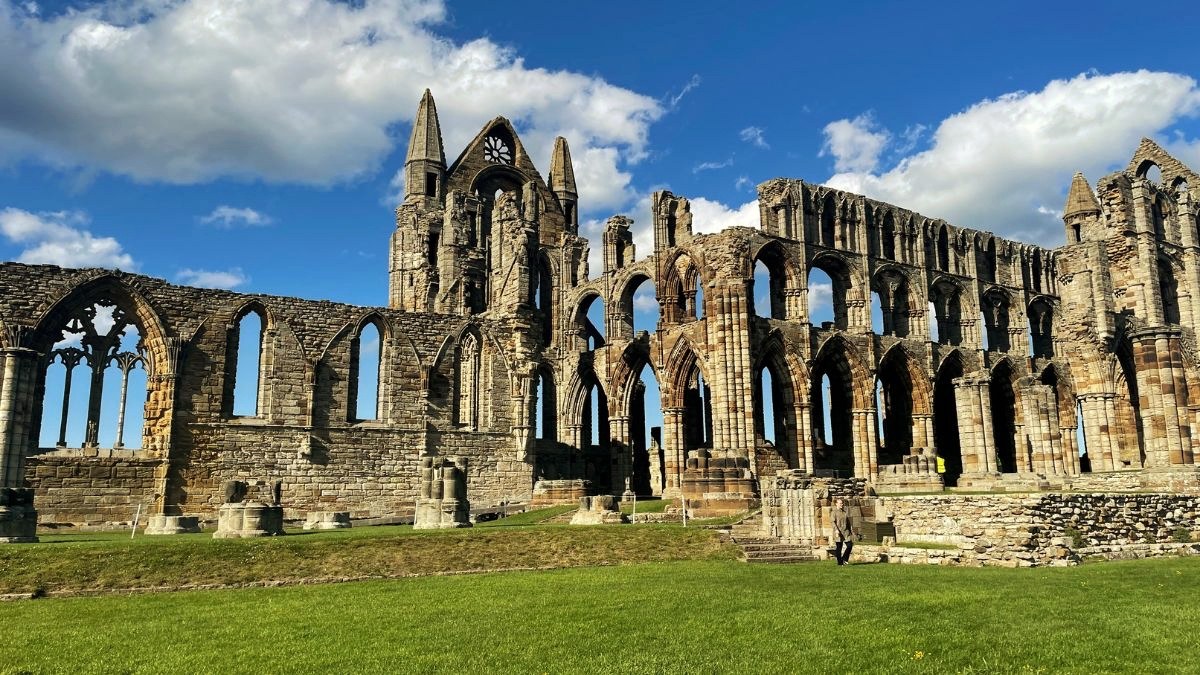
We did not get into the abbey, because it had shut by the time we reached the top of the steps. For what it is worth if you do go: adult walk-up is £11.80, it is free with English Heritage membership, and dogs on leads are allowed in the grounds, the visitor centre and the shop, though not the tearoom, which is run separately. Whether the ruin is worth a ticket when you can see it perfectly well for nothing over the churchyard wall is a judgement I will leave to you, and on a Friday evening ours was made for us. One thing that is easy to miss: English Heritage give 20% off entry if you arrive by bus, bike or train, and the Park and Ride counts.
Oversold. The Magpie Café. The food is good and Rick Stein has said as much, but you queue on the pavement for it and you pay restaurant prices rather than chippy prices. And the detail that matters here: only assistance dogs are allowed inside. The most famous fish and chips in Whitby is the one place you cannot take your dog. There is a takeaway counter that gets round it, and there are several perfectly good dog friendly chippies elsewhere in town, Hadley’s among them.
Church Street has pretty bones and is buried under Dracula tat and fudge. In August you shuffle. Walk through it once on the way to the steps and leave it at that.
The swing bridge is not overrated so much as a genuine bottleneck. When it opens for boats, everything crossing between the two sides of town stops.
Saturday: Ravenscar down to Robin Hood’s Bay
This is the day the whole weekend is built around, and it is the reason we picked the Bay over Whitby’s sand.
Drive to Ravenscar, about twenty five minutes, and do it as a loop. Out along the Cleveland Way clifftop path down to Robin Hood’s Bay, back on the Cinder Track, the old Scarborough to Whitby railway line. Roughly six miles all in, three to four hours with lunch.
Parking at Ravenscar cost us nothing. There is free roadside parking in the village and we left the car on the road near the visitor centre. It is not a National Trust car park, so there is no card to scan and nothing to pay.
Worth knowing that the reverse is true at the other end. Robin Hood’s Bay’s car parks are run by North Yorkshire Council, not the Trust, so membership does nothing there. Bank Top is £2.90 for an hour, £5.80 for four, £7.90 for twenty four, and charges only apply 9am to 6pm from 1 March to 31 October. Which means it is free out of season and free in the evening, and that is genuinely useful if you are timing a walk.
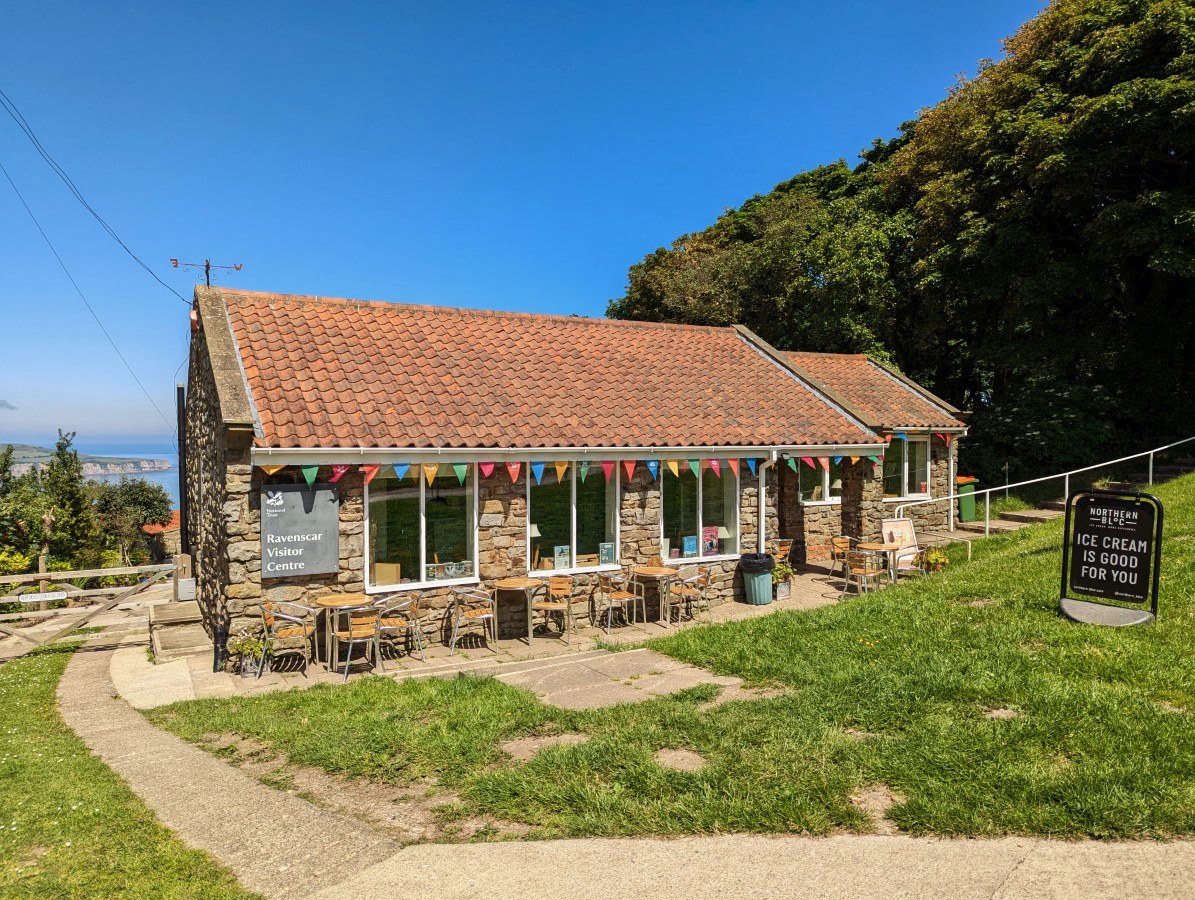
Before you set off, give Ravenscar twenty minutes. The National Trust visitor centre is free to go into, dogs are welcome inside on a short lead, there are picnic benches out front and a second hand book shelf where the money goes back into looking after the coast. We had a coffee there. There are public toilets just across the road.
Two other things at Ravenscar, both free. Peak Alum Works, the ruins of the alum quarrying operation on the cliffs below the village, which you can wander through and which is genuinely strange to walk around. Alum made this stretch of coast for a couple of hundred years. There is a wartime radar station site nearby too.
And the town that never was. In 1897 a company bought Ravenscar intending to build a rival to Scarborough. They laid out the streets, put in the drains, sold the plots, and went bust in 1911. Nothing was ever built. So you are walking on kerbstones for roads that do not exist. The visitor centre does a self-guided trail round it and a two mile countryside trail with rubbing plaques if you have children with you, and the booklets were a pound.
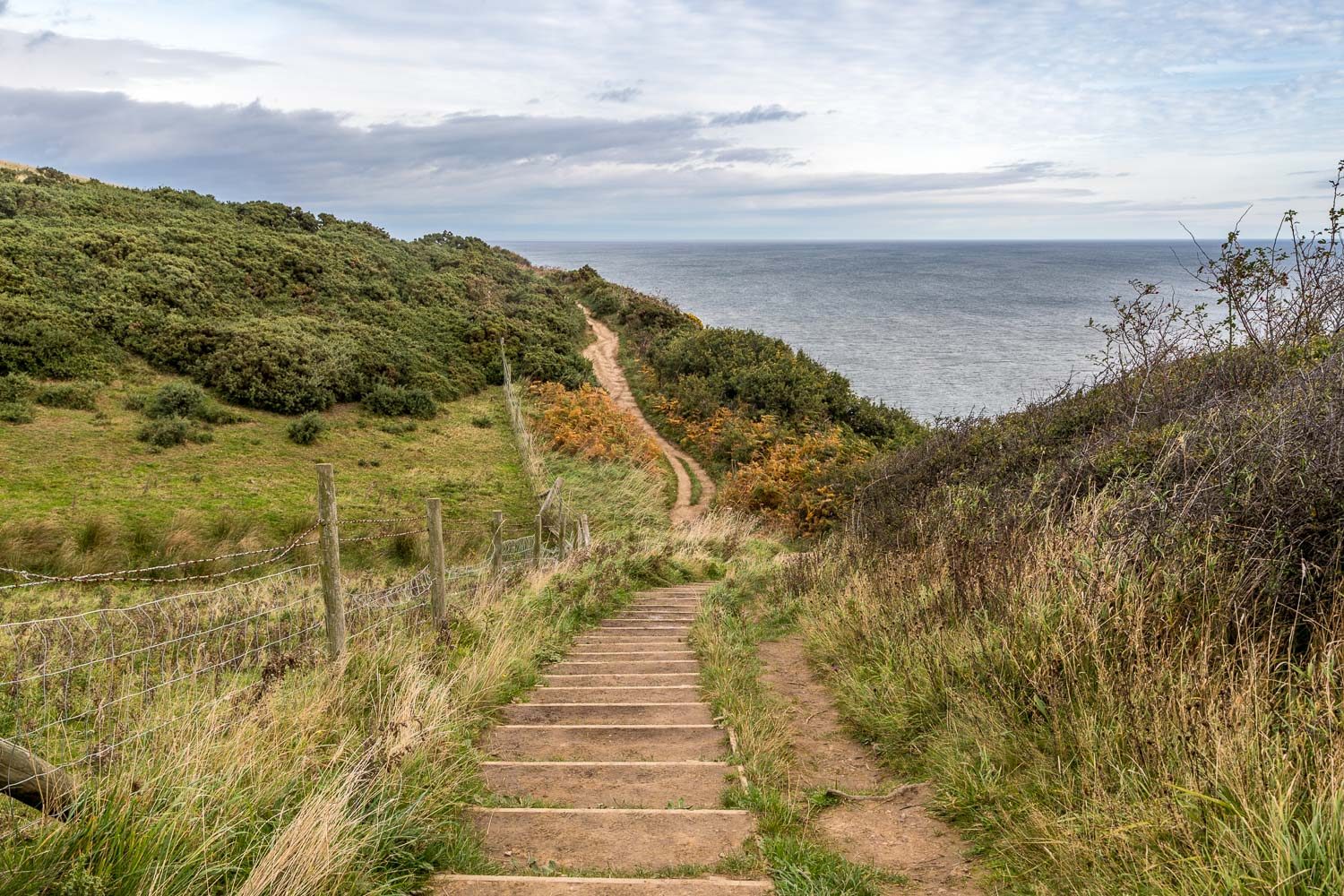
The clifftop leg was quieter than it had any right to be. Somewhere this popular, on a summer Saturday, and we barely passed anyone until we reached the village. The path runs along the top of the cliff with field on one side and a long drop on the other, so we kept the dog on the lead for the whole of that stretch and through the fields. The Cinder Track on the way back is where he got to go off lead, and after four miles of being clipped on he made the most of it.
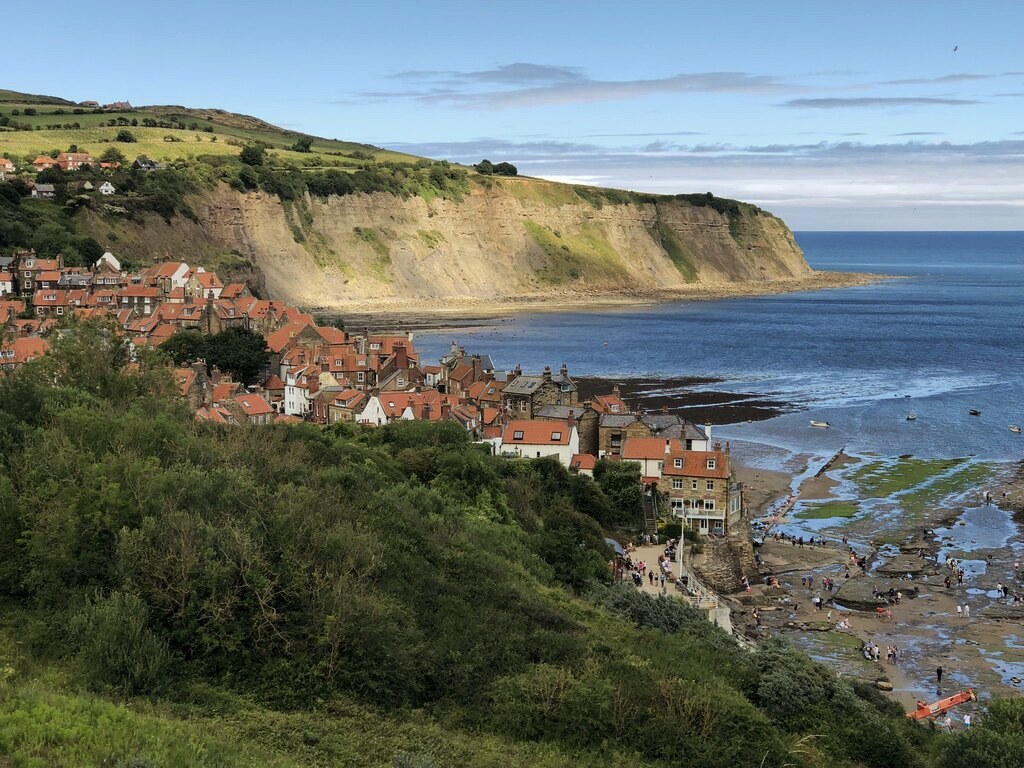
Then you come round the headland and the Bay is below you, which is the moment the walk pays for itself.
One thing to bear in mind before you commit to the descent. The village car parks are all at the top, and it is a steep drop down through narrow streets to the sea. Going down is easy. Coming back up is not, and if your dog is small or getting on, factor that in. Ours was fine. Plenty of people we passed on the climb had certainly worked up a sweat.
Lunch at The Bay Hotel, right on the slipway at the bottom, which is also the finishing line of the Coast to Coast. Grade II listed, two terraces of outdoor tables, dog welcome, and a view straight out over the scars at low tide. We had fish and chips outside (again!) and watched a steady trickle of people finishing a very long walk looking considerably worse than we did.
Also at the bottom, and free: the Old Coastguard Station at the dock. National Trust, free entry, dog friendly café downstairs and a small exhibition upstairs about the coast and its wildlife. Good shelter if the weather turns, which on that coast it does. If you want the quick version of lunch rather than a sit down, Fish Box does chips.
Check the tides before you commit to anything on the sand. It comes in fast at the Bay and people do get caught out down there. That is not a line I am adding for the sake of it.
Sunday: Falling Foss
After a full day of coastal wind we wanted something sheltered, and this was the right call. Woodland, a beck, a waterfall and a tea garden in the middle of nowhere.
Park at May Beck, about fifteen minutes from the hotel, and walk in along the beck through Sneaton Forest to the tea garden. Around thirty five minutes each way, or a four mile loop if you do the circular. The walk back along the decked path beside the water is the best part of it, so do the loop if you have the legs.
The parking is the bit to sort before you drive down. Both Sneaton Forest car parks charge, May Beck and Falling Foss, and I had read somewhere that May Beck was free. It is not, and several older guides still say it is. Rates were £1.35 for an hour, £2.85 for four and £4.85 all day, free for Forestry England national members.
The real problem is that there is no phone signal at the bottom of that valley, so we could not get RingGo to load at all. We noted the location code, drove out, and paid once we had a bar of signal back up the hill. That turns out to be the sanctioned way to do it: Forestry England allow payment up to midnight the day after your visit precisely because signal is poor. Note the code before you go down. May Beck is 31093. Falling Foss is 31092.
There are two car parks and the difference is a mile of walking. Falling Foss car park is a five minute walk from the falls. May Beck is nearly a mile. We chose May Beck deliberately because we wanted the walk, but if you just want to see the waterfall, park at Falling Foss and save your legs.
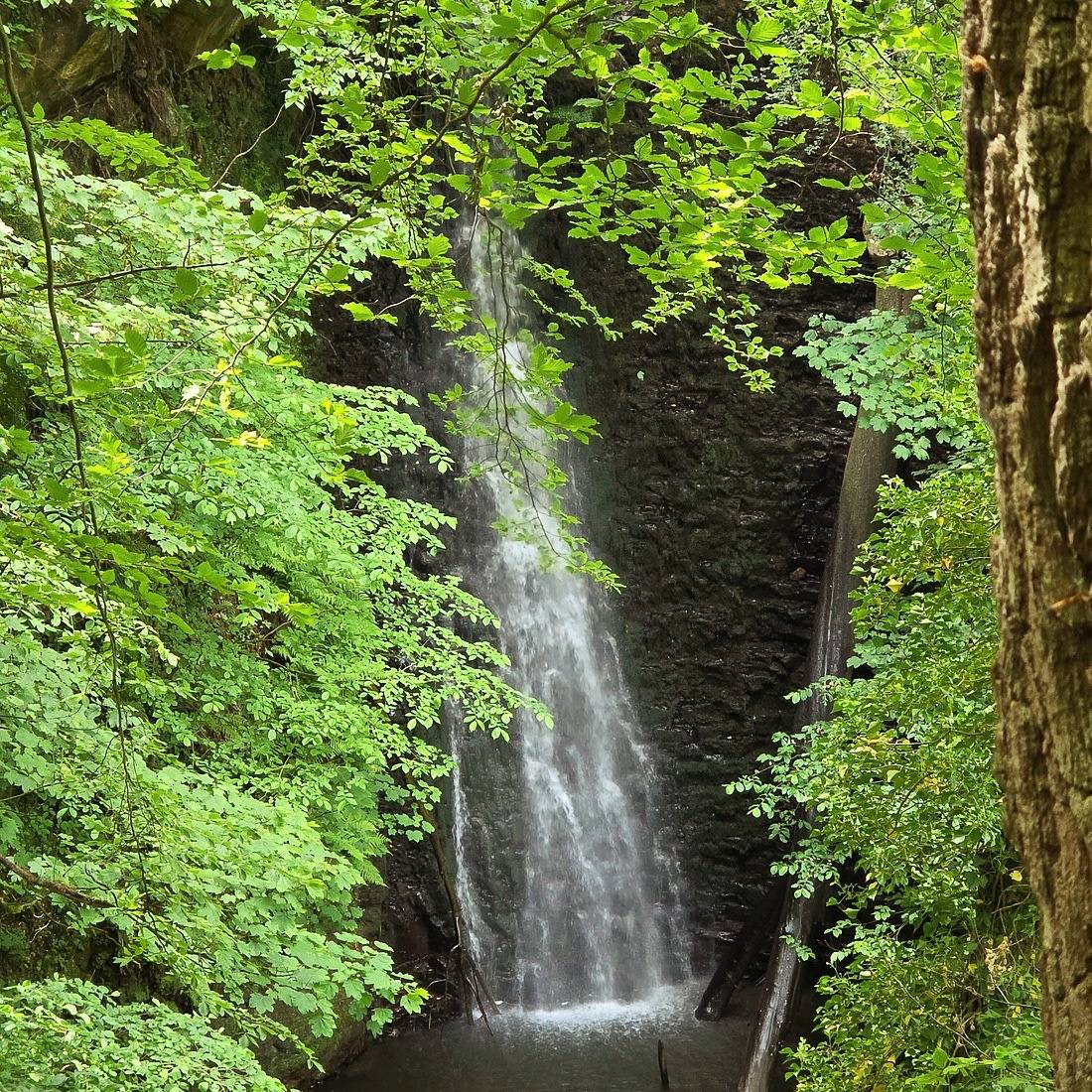
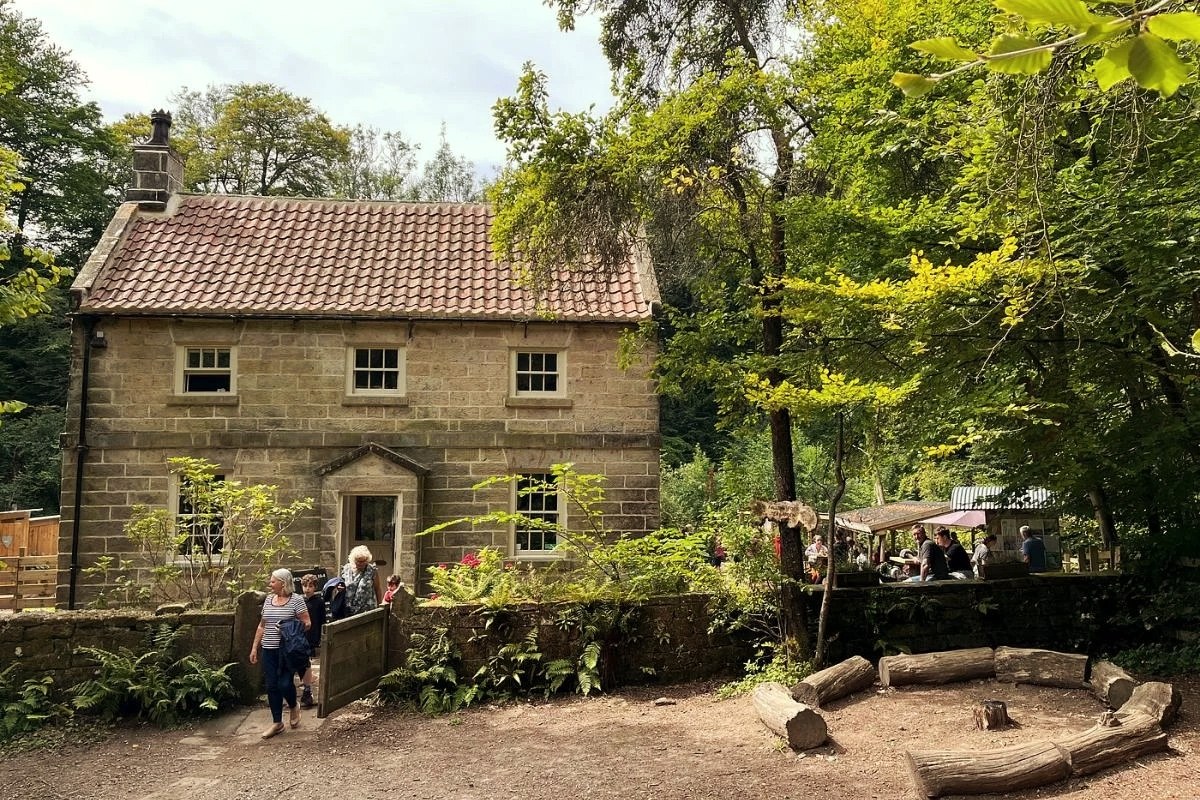
Falling Foss Tea Garden sits at Midge Hall, which is the actual name of the cottage. It is a gamekeeper’s cottage from the late 1780s, abandoned in the sixties and left derelict for about fifty years until a couple bought it in 2008 and reopened it. That history is why the place feels like something you have stumbled on rather than somewhere you have arrived at.
All the seating is outdoors, among wooden carvings, with the waterfall just past the garden. They are completely relaxed about dogs. The scones were good, the sandwiches are what people rate and they were right, and the coffee is better than it has any business being a mile into a wood. Check the opening days before you go, because the hours vary by season and it is not a place you want to walk to and find shut.
Two practical notes. There are steep unfenced drops on the path right by the falls, so ours went back on the lead for that stretch. And there are sheep on the last section back along the beck.
What we did not do
We nearly went to the Hole of Horcum instead, the huge natural amphitheatre off the A169 near Levisham. It is 400 feet deep and more than half a mile across, and the classic loop from Saltergate car park is about five miles, or seven to eight if you extend it via Levisham and Skelton Tower. Two and a half to three and a half hours. Saltergate was £5.50 all day last year.
We swerved it because we were there just after the twelfth and I did not know how much shooting there would be on the open moor. Falling Foss is woodland so that was not a factor. Next time, and if you go, the lead stays on the whole way: grazing stock, and ground-nesting birds from 1 March to 31 July.
Pro tips
Do not build a dog trip around Whitby’s beach. It is the single mistake this whole weekend is designed to avoid. Between May and September, put the beach day at Robin Hood’s Bay and treat Whitby as an evening.
Check the Park and Ride timetable for your actual dates. Outside 19 July to 6 September, the last bus back is before 7pm and the car park locks behind it.
Note the RingGo code before you drive into Sneaton Forest. There is no signal down there. You have until midnight the next day to pay.
Book the chippy. Hadley’s dog area is small and it fills.
Robin Hood’s Bay car park is free after 6pm and free from November to February, which is worth knowing if you are walking in the evening.
Neither end of the Ravenscar walk is a National Trust car park. The visitor centre is Trust and free to enter, but your membership card will not park you at either end.
Ask about the peacocks. Not a joke.
Nearby
Our other Yorkshire guide, a weekend in West Yorkshire based at Wentbridge, is the inland opposite of this one: a valley hotel, a sculpture park and a day in Leeds, and no dog. Take that one if you want galleries and a proper dinner rather than six miles of clifftop. Everything else we have written up in the county sits on the Yorkshire hub.
And if what you actually want is sand with no summer ban on it, the north Norfolk coast has no seasonal dog restrictions at all. Holkham is the one to start with, and the beach there is four miles long.